
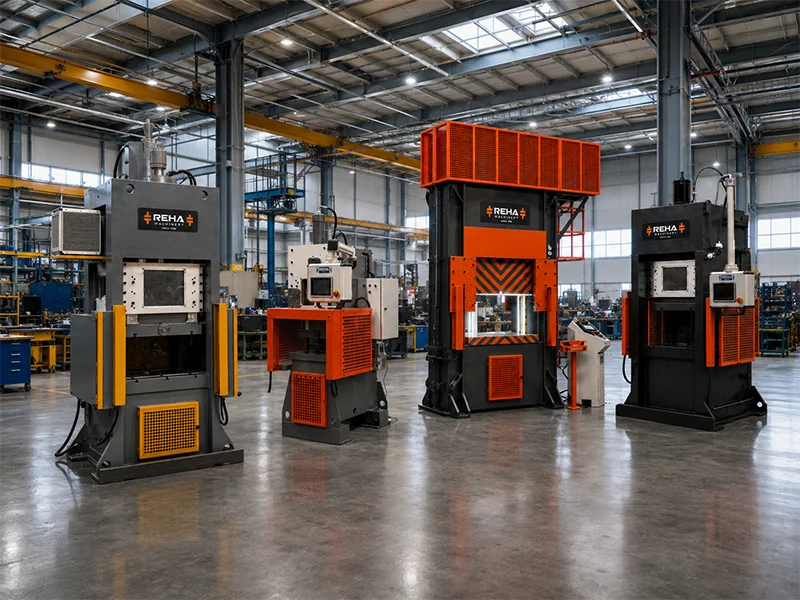
A hydraulic press is an industrial machine that uses hydraulic fluid pressure to generate high compressive force. Based on Pascal's principle, these systems transmit a small amount of force applied to fluid into a much greater force, allowing the shaping, pressing, bending, and cutting of various materials.
The working principle of a hydraulic press relies on hydraulic fluid moving between two different cylinders. A pump sends the hydraulic fluid to the main cylinder under high pressure. The piston inside the cylinder acts with this pressure, creating a high pressing force. Thanks to the fluid mechanics, a continuous and balanced power output is obtained.
Hydraulic presses are manufactured in different body structures based on production needs:
Each press type has a different body structure, operating features, and usage purposes. Therefore, when choosing the right machine, it is important to evaluate not only the press tonnage but the entire production process.
When choosing a hydraulic press machine, first, the production process and the technical features of the part to be produced must be determined.
The main criteria to consider when choosing a hydraulic press are:
Evaluating these parameters correctly helps determine a hydraulic press system suitable and efficient for the production capacity.
Reha Makina develops hydraulic press solutions for various industrial applications with its machine production experience since 1986.
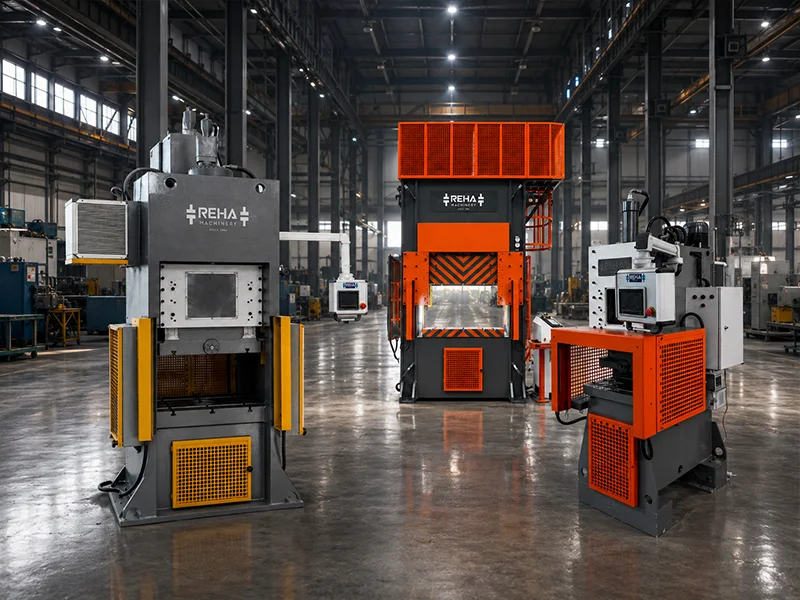
Offering solutions for different production needs from C-type, D-type, and H-type hydraulic presses to drawing and transfer presses, Reha Makina aims to add value to production processes with a strong engineering approach.
For detailed information about the hydraulic press solution suitable for your business according to the features of the part to be produced, the required capacity, and application details, you can contact Reha Makina.
 en
en  Türkçe
 Русский