
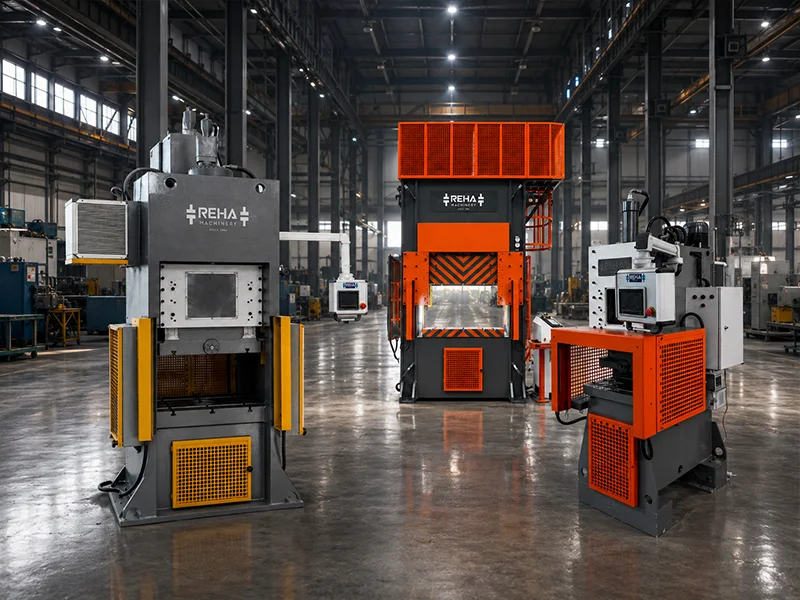
In industrial production, choosing the right hydraulic press is of great importance for production efficiency, part quality, and the process to be applied. Two of the most common hydraulic press constructions are C-type hydraulic press and H-type hydraulic press systems.
Although both press types operate with a hydraulic system, they differ from each other in terms of body construction, access to the working area, and purposes of use. Therefore, the choice of press must be evaluated according to the production process to be performed.
C-type hydraulic press takes its name from its open body structure that looks like the letter C when viewed from the side. This construction is preferred in various pressing and metal forming applications because it provides easy access to the working area.
Thanks to the open body design, placing and removing parts and molds into the working area becomes more practical.
Depending on the production need, different solutions such as C-type hydraulic drawing press and C-type hydraulic transfer press can also be used in addition to standard C-type presses.
H-type hydraulic press is a press system developed especially for industrial applications requiring high press force, with its strong body construction and wide working area.
The H-type body structure allows high pressing forces to be applied within a balanced construction. Therefore, H-type hydraulic presses can be preferred in applications involving the shaping of large parts, drawing, and heavy pressing.
The most fundamental difference between C-type and H-type presses is body construction.
In C-type hydraulic presses, access to the working area is easier thanks to the open body structure. In H-type hydraulic presses, a different construction is preferred for production processes requiring high force thanks to its strong frame structure.
Therefore, instead of evaluating which press type is better, it should be evaluated which press type is more suitable for the production to be performed.
C-type hydraulic press can be used in production processes where easy access to the working area is important, a more compact machine structure is preferred, and different mold applications will be performed.
Metal forming, pressing, bending, and various industrial production applications can be among the usage areas of C-type presses.
H-type hydraulic presses can be preferred in production processes requiring high press force, wide working area, or the use of larger molds.
Especially in applications such as heavy metal forming and drawing, H-type construction can provide advantages depending on the structure of the part to be produced.
Hydraulic drawing presses are used in applications requiring the controlled shaping of sheet metal within a mold.
A C-type or H-type hydraulic drawing press can be preferred depending on the geometry, material, required press force, and production method of the part to be produced.
When choosing a hydraulic press, looking only at the tonnage of the machine is not enough. The entire production process needs to be evaluated.
The main criteria to consider when choosing a press:
Evaluating these criteria together ensures the determination of the hydraulic press machine suitable for the production process.
Reha Makina develops C-type and H-type hydraulic press systems for the needs of different sectors with its production experience since 1986.
It offers alternatives for different capacities and production requirements with C-type hydraulic press, C-type hydraulic drawing press, C-type hydraulic transfer press, D-type hydraulic press, and H-type hydraulic press solutions.
By sharing the features of the part to be produced, the required tonnage, and your production process with Reha Makina, you can get detailed information about the suitable hydraulic press solution for your business.
 en
en  Türkçe
 Русский